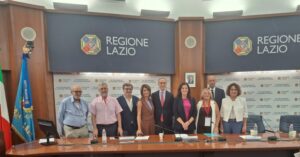
July 21, 2026
ROME, Lazio Region Executive Board Headquarters
On July 21, 2026, a conference organized by Councilor Dr. Micol Grasselli took place in Rome at the Lazio Region Executive Board headquarters to present and discuss Lazio Region Determination No. 472/2026 regarding hearing aids.
Lazio Region Determination No. 472/2026 amends Determination No. 889/2025, a measure that had caused significant distress among citizens who rely on hearing aids. The associations USHER ITALIA A.P.S., La Chiocciolina A.P.S., FIADDA ROMA A.P.S., Movimento LIS Subito, and E.N.S. Rome considered the earlier determination unfair; while they initially contemplated legal action, they instead requested and secured a dialogue with the Lazio Region to present the positions and concerns of deaf and hard-of-hearing individuals.
Indeed, among other things, the Associations complained that the reimbursement rates for digital hearing aids were significantly below market price and that the principle of “therapeutic continuity” had been violated; this was because code 22.06.15.018—which identifies hearing aids with advanced technical features (multi-channel, binaural synchronization, wireless accessories)—was authorized only for patients up to the age of 18, meaning that pre-verbal and peri-verbal adults, from the age of 18 years and one day onwards, would be entitled only to a digital device (code 22.06.15.021) that was inadequate for their degree of hearing loss.
The work of the Technical Working Group spanned approximately eight months. Participants included the associations USHER ITALIA A.P.S., La Chiocciolina A.P.S., FIADDA ROMA A.P.S., Movimento LIS subito, and E.N.S. Roma; representing the Lazio Region were Dr. Andrea Urbani (Regional Director for Health and Socio-Health Integration), Dr. Marzia Mensurati (Medicines and Devices Unit), Dr. Daniela Botta, Dr. Alessandra Carrocci, and Dr. Giorgio Balsamo (Director of the Cochlear Implant Center at ASL Roma 2 and the Otorhinolaryngology Unit at S. Eugenio Hospital); as well as representatives of hearing aid specialists and hearing aid manufacturers, and Dr. Giovanni Ricciardi, delegate for Councilor Dr. Micol Grasselli.
This led to Resolution No. 472/2026, which stipulates the following:
– “to approve the ‘Regional Nomenclature for Hearing Aids’—as updated regarding the tariff and technological requirements for the acquisition of the digital behind-the-ear device (LEA code 22.06.15.018), which is attached to and forms an integral and substantial part of this resolution, replacing the version adopted via Regional Executive Board Resolution (D.G.R.) No. 889 of October 9, 2025;
– to expressly exclude the application of the ‘reducibility’ mechanism (allowing for the reimbursement of a different device based on the tariff of another) at the time of supply for the hearing device provided at the newly determined tariff;
– to establish that, in application of the principle of continuity of care, the tariff of €1,750.00 for the provision of the aforementioned device shall be guaranteed and recognized for patients suffering from severe and profound deafness (pursuant to Law No. 381/1970) throughout their entire lives, thereby exceeding the maximum age limit of 18 years previously established for the provision of such a device at the expense of the regional health service.”
In her address, Laura Orsatti, President of USHER ITALIA A.P.S., highlighted the deeper significance of Lazio Region Resolution No. 472/2026, noting that it transcends the measure’s explicit content.
She asserted that when a public authority regulates a specific matter while listening to the “voice” of the citizens directly affected, the resulting legal rule inevitably fulfills its fundamental purpose: ensuring social harmony.
A just legal rule fosters social harmony, whereas an unjust one fails to do so; instead, it breeds discontent, dissatisfaction, and conflict.
Given this positive experience, the President concluded by expressing the hope that the Lazio Region would adopt—as its standard *modus operandi*—the practice of establishing technical roundtables with the citizens directly affected by the matters under regulation.